How Is The Sun Today?
A quick read on the Sun in one score from 0 to 10, plus the three official storm meters the U.S. government uses to warn about space weather.
Reading today's space weather…
See The Sun Right Now
The latest pictures from NASA and NOAA spacecraft watching the Sun around the clock. Each camera sees a different layer, so each shows something different. Tap a picture to see it full size; tap Close (or anywhere around it) to come back.
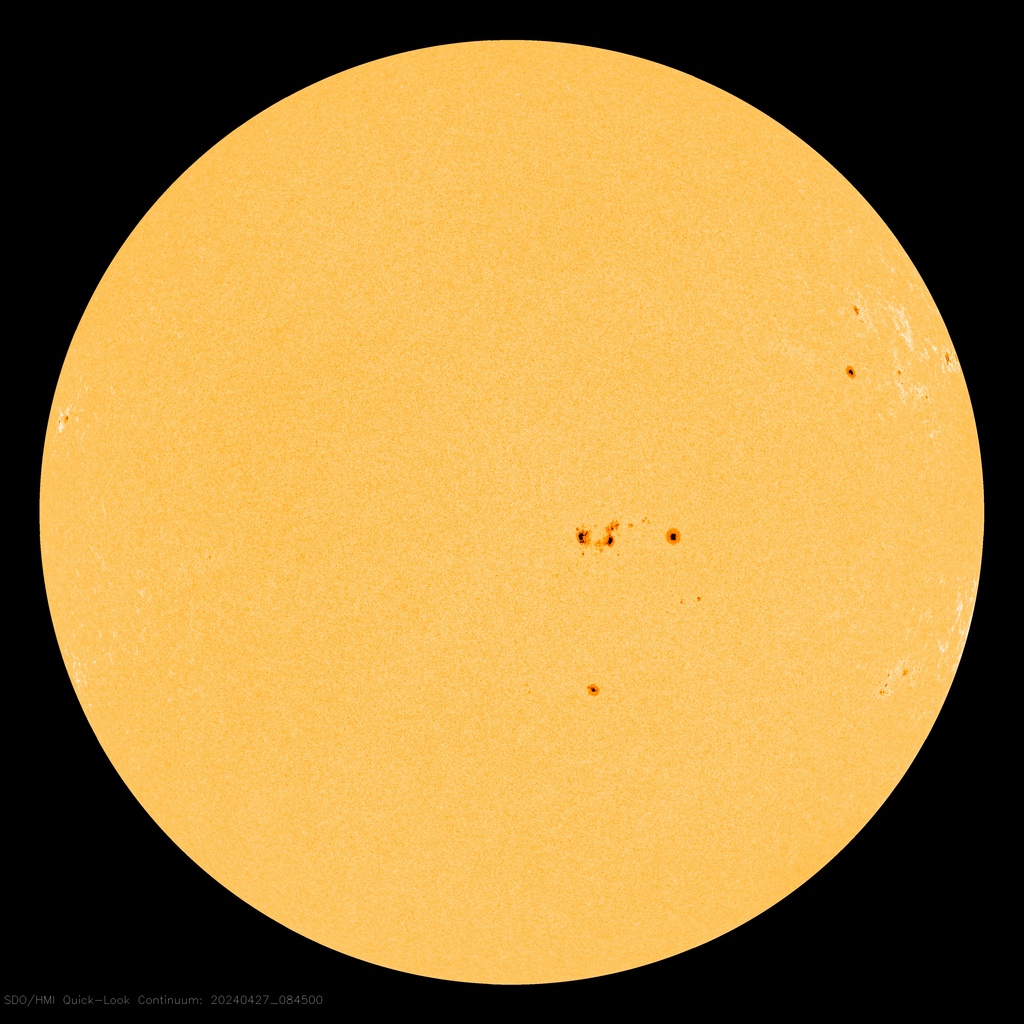
Sunspots
The Sun as your eyes would see it through a safe filter. The dark spots are sunspots: cooler areas with tangled magnetic fields, where flares are born.NASA Solar Dynamics Observatory · updates about every 15 minutes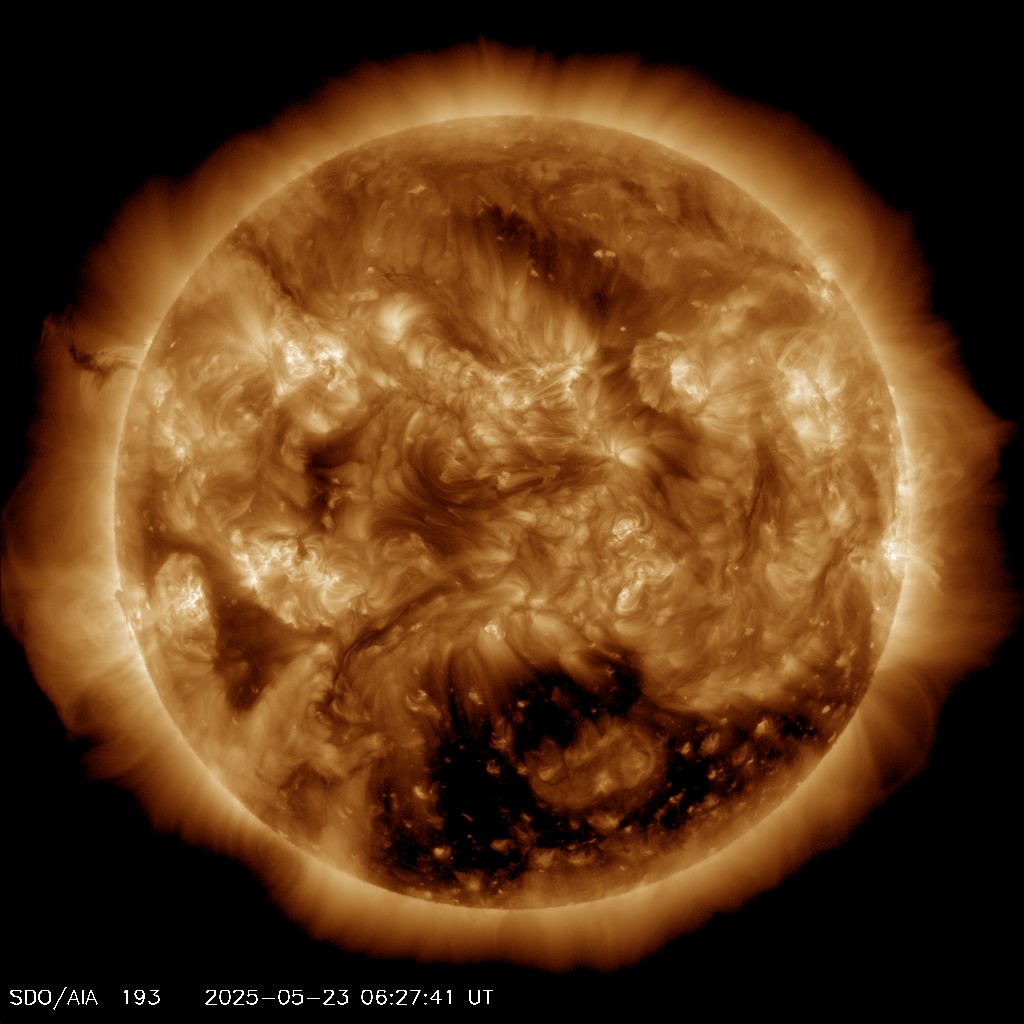
The Corona And Coronal Holes
The Sun's million-degree outer atmosphere in ultraviolet light. Bright patches are active regions. Large dark patches are coronal holes, which blow fast solar wind toward Earth when they face us.NASA Solar Dynamics Observatory, 193 Å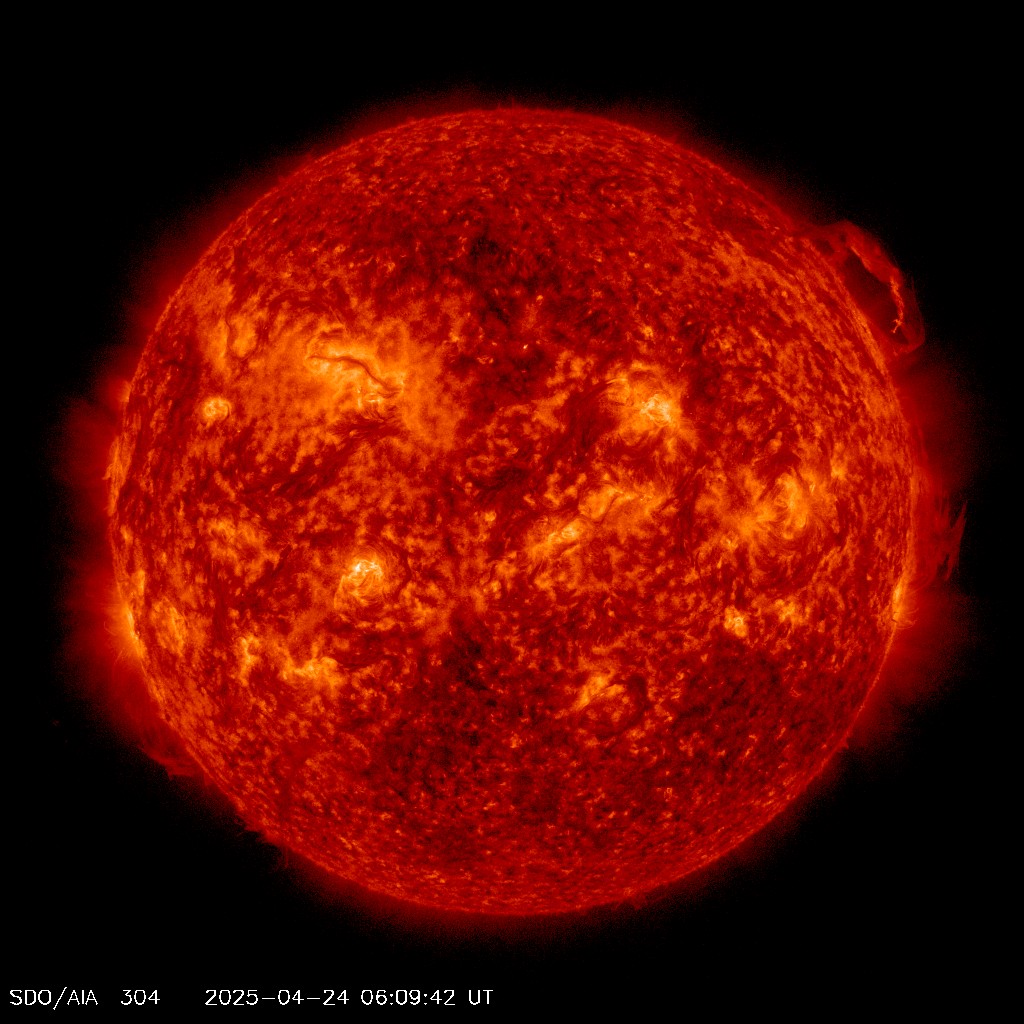
Flares, Filaments And Prominences
A cooler layer just above the surface. Flares show up as sudden bright flashes. Dark threads are filaments, and loops over the edge are prominences. When one snaps, it can launch a CME.NASA Solar Dynamics Observatory, 304 Å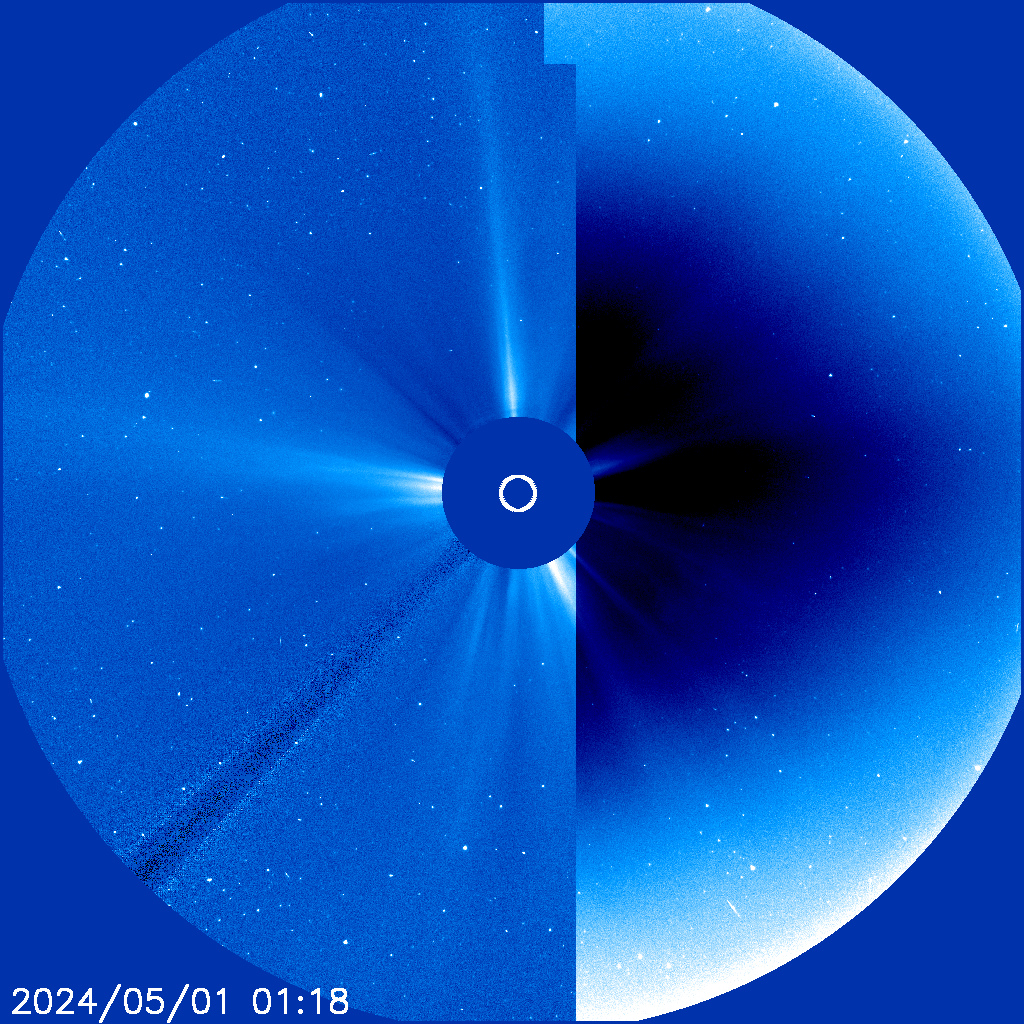
The CME Camera
A disk blocks the bright Sun (the white circle shows its size) so the faint outer corona shows. A CME looks like a bright cloud bursting outward. One that spreads all the way around the disk, a "halo," is headed toward or away from Earth.NASA/ESA SOHO LASCO C3 coronagraph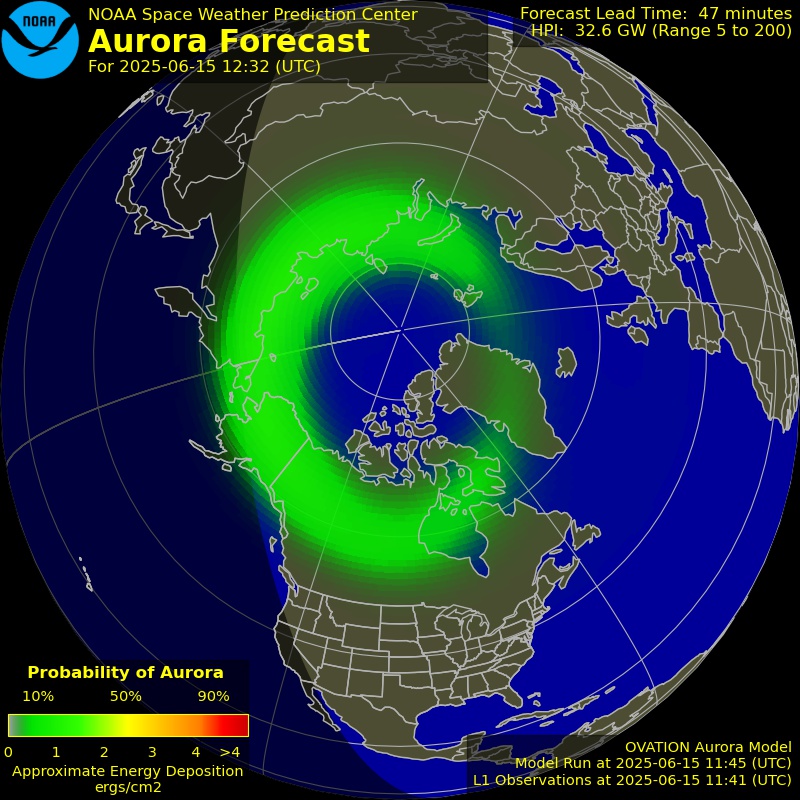
Northern Lights Forecast
Where auroras are likely in the next half hour. Green is a faint chance, red a strong one. The red line marks how far from the oval you could still see auroras low on the horizon.NOAA OVATION aurora model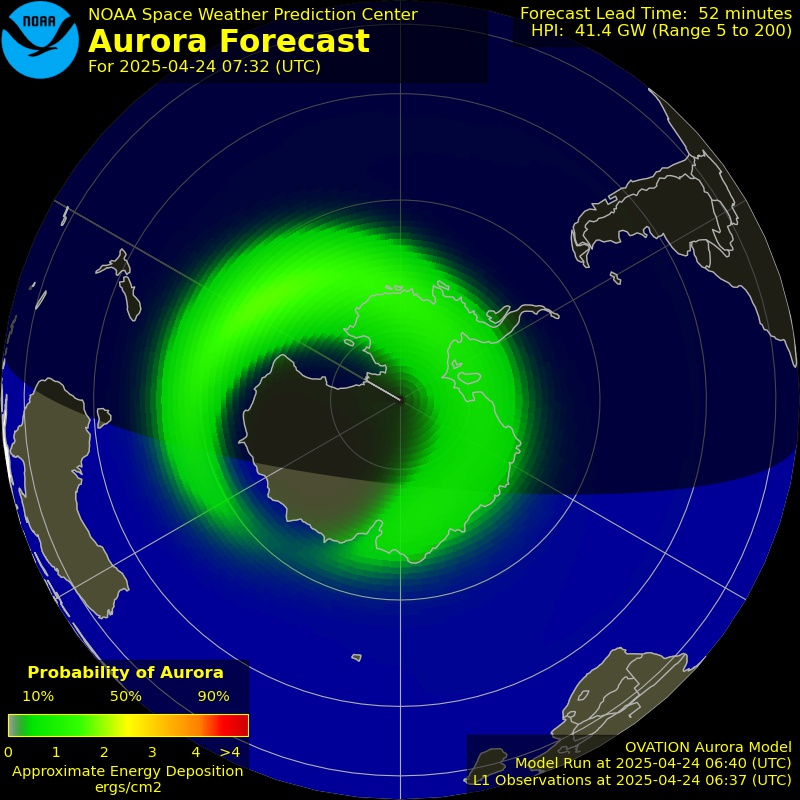
Southern Lights Forecast
The same forecast for the Southern Hemisphere, for viewers in Australia, New Zealand, South America and Antarctica.NOAA OVATION aurora modelSolar Flares And Radiation
A flare is a sudden flash of X-rays that reaches Earth in about 8 minutes. Big ones can knock out shortwave radio on the sunlit side of Earth. The strongest can also throw off fast particles that cause radiation storms.
X-Ray Brightness, Last 3 Days
This line is the Sun's X-ray output measured by NOAA's GOES satellite. Each spike is a flare. The colored bands are the flare classes. Each band is 10 times stronger than the one below it, so an X flare is 10 times an M and 100 times a C.
Chance Of A Big Flare
NOAA's forecast for the whole Sun.
Flares In The Last 7 Days
Radiation From The Sun
High-energy protons measured by GOES. When this line crosses the red dashed line (10 units), NOAA declares a radiation storm. Radiation storms matter for astronauts, polar airline flights and satellites, not for people on the ground.
Solar Wind, Magnetic Storms And Auroras
A stream of charged particles flows from the Sun all the time. When it speeds up, thickens or carries a magnetic field pointing south, it shakes Earth's magnetic field. That shaking is what makes auroras.
The Solar Wind Right Now
Measured by spacecraft about 1.5 million km (930,000 mi) toward the Sun, about 30 to 60 minutes before the wind reaches Earth.
Speed And Density, Last 30 Days
Normal wind is about 300–400 km/s (190–250 mi/s). Above 500 km/s (310 mi/s) is fast, usually from a coronal hole or a CME.
Magnetic Storms (Kp), Past Week And Next 3 Days
Kp measures how hard Earth's magnetic field is shaking, every 3 hours, from 0 to 9. Kp 5 or more is a geomagnetic storm (G1 to G5). Lighter bars are NOAA's forecast.
Where Could You See The Northern Lights?
The higher the Kp, the farther from the poles auroras reach. Roughly:
| Kp | Storm level | North America | Europe |
|---|---|---|---|
| 3–4 | None | Alaska, northern Canada | Iceland, northern Scandinavia |
| 5 | G1 Minor | Northern border states: Montana, North Dakota, Minnesota, northern Maine | Scotland, southern Norway and Sweden |
| 6 | G2 Moderate | Washington, Wisconsin, Michigan, New York | Northern England, Denmark |
| 7 | G3 Strong | Oregon, Iowa, Illinois, Pennsylvania | Ireland, Germany, Poland |
| 8 | G4 Severe | Northern California, Colorado, Kansas, Virginia | France, northern Italy |
| 9 | G5 Extreme | Much of the U.S., as far south as Texas and Florida in rare cases (as in May 2024) | Spain, southern Italy |
Best viewing: a dark site away from city lights, looking toward the pole, between about 10 PM and 2 AM local time. Phone cameras often pick up auroras the eye can barely see.
Sunspots And The Solar Cycle
Sunspots come and go in a cycle that lasts about 11 years. At its peak (solar maximum) the Sun has many spots and many flares; at its low point it can go weeks with none. We are now in Solar Cycle 25.
Active Sunspot Groups Today
Each sunspot group gets a number. Groups near the center of the Sun face Earth directly, so a CME from one of them is more likely to head our way. The more tangled the magnetic field, the bigger the flares a group can make.
Daily Sunspot Number, Last 4 Months
An official daily count that weighs both the number of groups and the number of spots in them.
The Next 4 Weeks
NOAA's 27-day outlook. The Sun turns once about every 27 days, so active regions and coronal holes tend to come back around. Bars are the expected highest Kp each day; the gold line is the expected radio brightness (see the glossary).
Solar Cycles 23, 24 And 25
Monthly sunspot numbers since 1996. The thick line is the smoothed trend that scientists use to date each solar maximum and minimum. The shaded band is NOAA's prediction for the years ahead.
Alerts, Glossary And Links
The latest notices from NOAA's Space Weather Prediction Center, the terms you will hear on space weather shows, and where to learn more.
Latest NOAA Alerts
Newest first. Times are UTC. A watch means something may happen; a warning means it is about to; an alert means it is happening now.
Glossary
- Solar flare
- A sudden flash of light and X-rays from a sunspot group, graded A, B, C, M and X. Each letter is 10 times stronger; the number after it (M2.5) is a finer step.
- Coronal mass ejection (CME)
- A huge cloud of charged gas thrown off the Sun. An Earth-directed CME arrives in 1 to 4 days and can cause a magnetic storm.
- Coronal hole
- A dark area in ultraviolet pictures where the Sun's field opens into space, letting fast solar wind escape.
- Solar wind
- The constant stream of charged particles from the Sun, normally 300–400 km/s (190–250 mi/s).
- Bz
- The north-south direction of the magnetic field carried in the solar wind, in nanoteslas (nT). Southward (negative) Bz lets energy into Earth's field.
- Kp index
- A 0–9 measure of how disturbed Earth's magnetic field is, updated every 3 hours. 5 or more is a storm.
- R, S and G scales
- NOAA's 1–5 storm ratings: R for radio blackouts from flares, S for solar radiation storms, G for geomagnetic storms.
- Radio flux (F10.7)
- How brightly the Sun shines in 10.7 cm radio waves, in solar flux units. Around 70 means a quiet Sun; above 150 a very active one.
- Proton event
- A burst of fast particles, usually after a big flare, that can reach Earth within an hour. Causes S-scale radiation storms.
- Filament and prominence
- A long cloud of cooler gas held above the surface by magnetic fields; dark against the disk (filament), bright over the edge (prominence).
- Magnetic class (Alpha, Beta, Gamma, Delta)
- How mixed a sunspot group's magnetic field is. Alpha is simple; Beta-Gamma-Delta is the most tangled and the most likely to make X flares.
- Solar maximum and minimum
- The high and low points of the roughly 11-year sunspot cycle.
Learn More
- Ben Davidson, Space Weather News Report (daily video) and X: @SunWeatherMan
- NOAA Space Weather Prediction Center, the official U.S. forecasts and alerts
- NASA Solar Dynamics Observatory, more pictures and movies of the Sun
- SOHO real-time images, including CME movies
- Pole Shift News, the daily digest by David Sunfellow